System Administration Training in Kottayam
Our Training/Internship Process

System Administration - Syllabus, Fees & Duration
MODULE 1
- System administration introduction, policies, overview, UNIX history and basis
MODULE 2
- File systems and disks
MODULE 3
- Software installation concepts
MODULE 4
- Multi users basics, politics, policies and ethics
MODULE 5
- Automating administrative tasks
MODULE 6
- Networking
MODULE 7
- Backup and disaster recovery
MODULE 8
- DNS
MODULE 9
- SMTP, HTTP
MODULE 10
- Configuration management
MODULE 11
- Distributed computing
MODULE 12
- SNMP, monitoring
MODULE 13
- System security
This syllabus is not final and can be customized as per needs/updates
- Since 2001, Making IT Experts by Experts
- Duration: 25 Hours (Vary as per your skill)
- Course Fees
- Individual Live Classes (1:1)
- Batch Classes @ Low Fees
- Training on Your Time, Any Where
- Access to Recorded Videos
- Practical Internship on Projects
- 100% Placement Support by our jobsHybrid.com
- Training/Internship Certificate
- Agra
- Ahmedabad
- Alappuzha
- Aurangabad
- Bangalore
- Belgaum
- Bellary
- Bhubaneswar
- Chennai
- Cochin
- Coimbatore
- Delhi
- Dindigul
- Erode
- Gulbarga
- Guntur
- Gurgaon
- Haryana
- Hyderabad
- Idukki
- Indore
- Jaipur
- Kalyan
- Kannur
- Kanpur
- Kasaragod
- Kerala
- Kolkata
- Kollam
- Kottayam
- Kozhikode
- Lucknow
- Madurai
- Malappuram
- Mangaluru
- Mumbai
- Mysuru
- Nagpur
- Nashik
- Navi Mumbai
- Nizamabad
- Noida
- Palakkad
- Pathanamthitta
- Pune
- Punjab
- Salem
- Shimla
- Solapur
- Surat
- Thane
- Thanjavur
- Thirunelveli
- Thoothukudi
- Thrissur
- Tiruchirappalli
- Tiruppur
- Trivandrum
- Vadodara
- Varanasi
- Vellore
- Vijayawada
- Visakhapatnam
- Wayanad
Course Highlights

Our Locations

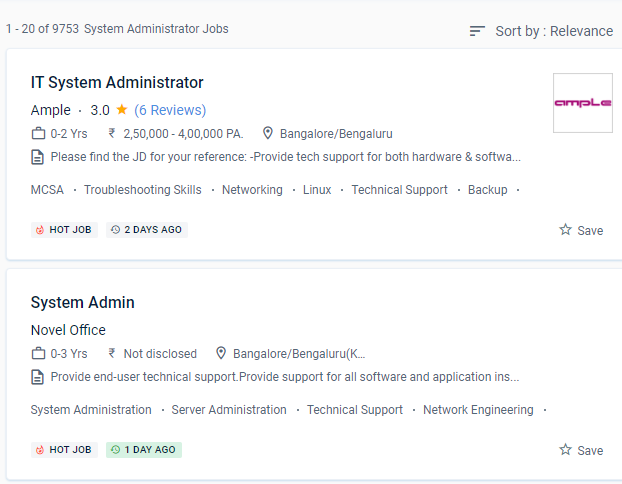
 The System Administration course in Kottayam will take you from working on a single machine to managing a complete fleet. Some people excel at determining the company's technology needs as information systems managers. Finally, you'll discover how to restore your company's IT infrastructure following a disaster.
For secure, high-speed Internet access, they connect routers, modems, and firewalls. You'll also learn how to manage and configure servers, as well as how to manage PCs, user information, and user productivity using industry tools. You now understand what system administration entails, as well as the functions that system administrators execute and the talents that system administrators possess. Information technology (IT) experts execute the work of systems administration for a company.
They set up the network card (NIC) so that data can be sent and received appropriately.
To digitally connect clusters of computers, they create local area networks (LANs) and wide-area networks (WANs). This course will teach you about the infrastructure services that keep all businesses, big and small, running smoothly.
The System Administration course in Kottayam will take you from working on a single machine to managing a complete fleet. Some people excel at determining the company's technology needs as information systems managers. Finally, you'll discover how to restore your company's IT infrastructure following a disaster.
For secure, high-speed Internet access, they connect routers, modems, and firewalls. You'll also learn how to manage and configure servers, as well as how to manage PCs, user information, and user productivity using industry tools. You now understand what system administration entails, as well as the functions that system administrators execute and the talents that system administrators possess. Information technology (IT) experts execute the work of systems administration for a company.
They set up the network card (NIC) so that data can be sent and received appropriately.
To digitally connect clusters of computers, they create local area networks (LANs) and wide-area networks (WANs). This course will teach you about the infrastructure services that keep all businesses, big and small, running smoothly.